
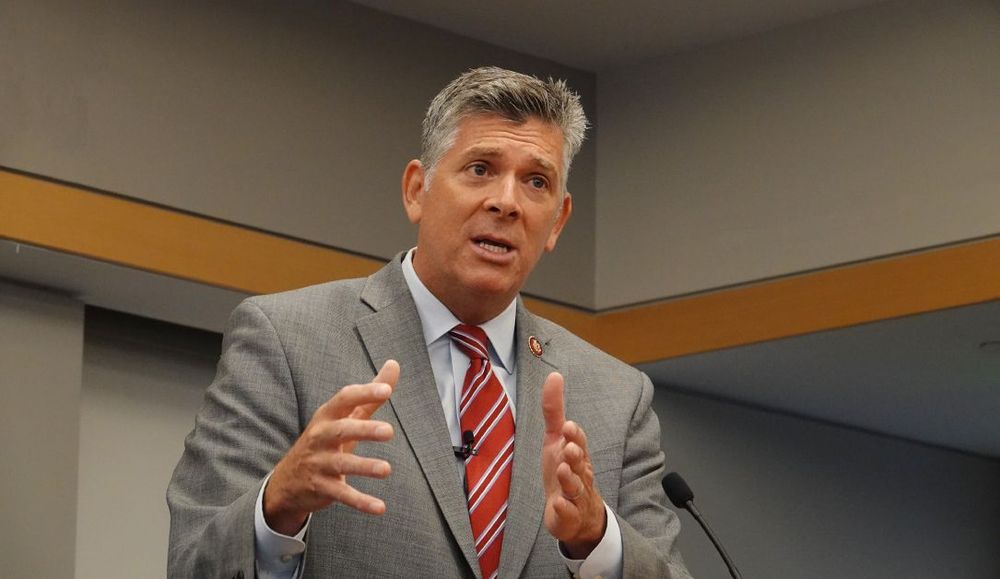
Rep. LaHood on why Section 702 reauthorization will take a ‘little political muscle’
After months of inaction, next week could prove pivotal to extending a major surveillance program.
Section 702 of the Foreign Intelligence Surveillance Act (FISA), which allows the federal government to collect, without a warrant, the electronic communications of foreigners abroad, will sunset on April 20 without congressional action [Editor’s note: Lawmakers pushed the vote on renewing FISA to the week of April 14 since this interview was published].
Rep. Darin LaHood (R-IL) on Thursday used his time during the public portion of the House Intelligence Committee’s annual worldwide threats hearing to get the nation’s top spies on the record in support of President Donald Trump’s plan for a 18-month “clean” reauthorization of the authority, which his Capitol Hill allies will attempt to pass next week.
Recorded Future News sat down with LaHood, the chair of Intelligence panel’s NSA subcommittee and a member of its FISA working group, in his Capitol Hill office immediately following the open portion of the hearing to talk about his impressions, recent issues that have cropped up around 702 and what needs to be done to get a renewal over the finish line.
This conversation has been edited for length and clarity.
Recorded Future News: What were your takeaways from today’s public hearing?
Darin LaHood: I was glad we had clarification on the president’s position on an 18-month clean reauthorization. And pushing for that and the justification for that, which I think is very much warranted from CIA Director John Ratcliffe and Director of National Intelligence Tulsi Gabbard — and obviously the reforms we put in place were articulated briefly by FBI Director Kash Patel today.
It gives us a clear window of what we need to do.
RFN: To be clear, you yourself support an 18-month extension?
DL: I would prefer longer than that. I would extend for 10 years because I think it's important that we have this for a long period of time. But the president has made the decision that it's an 18-month clean reauthorization. I'm glad that there is not a warrant requirement. That's been a problem in the past.
We’re 30 days out. We don't have a lot of time here. I know House Speaker Mike Johnson has talked about bringing this to the floor next week. That seems to be the play right now and obviously I look forward to supporting it.
RFN: What are your top reasons for supporting a renewal without tweaks?
DL: This is the singular most important collection item we have in our intelligence portfolio. It is indispensable to our national security in so many different ways.
It’s been involved with the release and recovery of the Israelis held hostage by Hamas in the tunnels. That wouldn't have happened without 702. The flawless operation in Venezuela wouldn't have happened but for 702. The current troop protection that we have in place in Iran and through Operation Epic Fury wouldn't have happened without 702. The successes we've had in Ukraine wouldn't have happened without 702.
And I would just say, from a personal standpoint, I'm a former federal terrorism prosecutor with the U.S. Department of Justice. I've seen how FISA 702 was impactful for my own prosecutions.
Couple that with the reforms we put in place, 56 of them through the Reforming Intelligence and Securing America Act two years ago — I believe those have been properly implemented. I believe they're working to hold the FBI accountable.
We need to let these reforms continue to be implemented and work. But this is not the time to let this program go dark. And, most importantly, we do not need a warrant requirement, as the president has articulated.
RFN: FBI searches of the Section 702 database were at the center of the last renewal debate. You yourself were the subject of such a search. Last week we reported that FBI queries rose by about 35 percent from the previous year. What do you make of that? Have you received an explanation for the jump?
DL: We have had briefings on that and I'm satisfied.
When you look at that increase again, because of the reforms that have been put in place, it's all been done within the framework of the 2024 legislation, and I'm satisfied that it's working the way that it should.
Prior to our reforms, about 7,500 FBI personnel had the ability to query U.S. citizens. That's now down to about 3,500. Second, putting in criminal liability and criminal penalties for FBI agents that engage in unlawful queries of U.S. citizens has changed. The query protocols have all changed.
RFN: What explanations were you given for the increase?
DL: Some of those are just mistakes, like misspellings. Some of it has been the drug cartels and involvement with that. Remember, we expanded 702 to include fentanyl and the precursors for fentanyl that pertain to the drug cartels. Some of that has been related to that.
I was satisfied with all of the explanations that we received from both the NSA, which plays a pivotal role here, and also the FBI.
RFN: Turning to next week, what if the push fails? Do you foresee short-term extensions instead?
DL: I don't want to get into the three dimensional chess and the hypothetical.
Next week, having House Judiciary Committee Chair Jim Jordan on board publicly with an 18-month clean reauthorization, having President Trump on board with an 18-month clean reauthorization as the commander-in-chief — I don't know how our Republican colleagues do not support that.
It's going to take a little political muscle. There's no doubt about it, we're going to have to have the president weigh in. There hasn't been a public statement from the president, there hasn't been anything on Truth Social social, there hasn't been anything in terms of vocalizing a 702 clean reauthorization. But we're going to need that next week.
And some of our members who have not supported us in the past, they’re going to have to listen to the commander-in-chief. They're going to have to listen to the president and his reasoning and I think there's a good likelihood we’ll get it done.


Martin Matishak
is the senior cybersecurity reporter for The Record. Prior to joining Recorded Future News in 2021, he spent more than five years at Politico, where he covered digital and national security developments across Capitol Hill, the Pentagon and the U.S. intelligence community. He previously was a reporter at The Hill, National Journal Group and Inside Washington Publishers.